Showing posts with label -Miscellaneous. Show all posts

Thursday, 28 July 2022

Gas lamps


-SG- I recently came across the Powell and Hanmer advert attached.  Nothing really to do with Nortons  except that vast numbers of Norton owners in the twenties and earlier would have used acetylene lamps and P and H were a major supplier.  I found the text in the centre of the advert quite amusing and typical of twenties humour.  Note there are no acetylene rear lamps shown - for the good reason that rear lights did not become compulsory in the UK until about 1927 so the advert must date from earlier than that.

When I was a lot younger and even more foolish than I am now, I actually fitted an acetylene head lamp to my 1930 Norton which I was using to go to work.  It was surprisingly good but oncoming drivers, presumably not recognising the pool of light as coming from a vehicle, seemed unwilling to dip their head lights, so the idea was quickly abandoned. Incidentally,  I did not have an acetylene rear lamp so fitted an illegal cycle rear lamp to the side of the number plate! 


Friday, 27 May 2016

1940 Model WD16H Norton


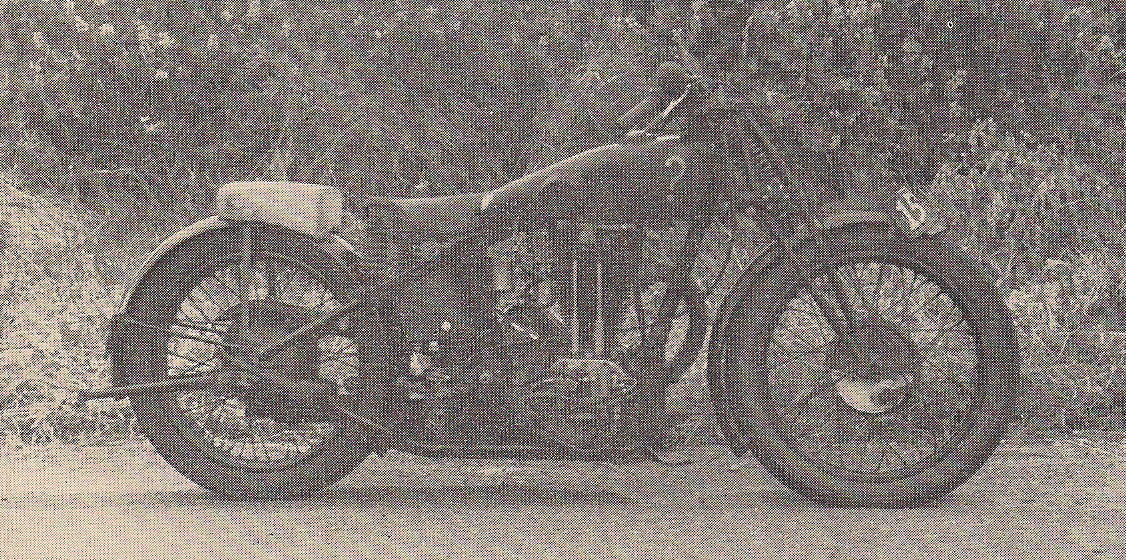
-JdK- Roberto in the UK and his mini digger came across these remains of this Norton, identified as a 1940 WD16H by the number. The owner of a scrapyard selling used bike parts since the 1950s explained to me once that he always discarded frames; they took up too much space and there was only demand for engines, gearboxes and smaller parts anyway.

Tuesday, 23 February 2016

When is a Norton not a Norton ...


-SG- Here's another bike which rather falls into this category - labelled on the tank as a Norton Superior, it apparently has a pre-war 16H frame/forks/gearbox, and a Matchless twin engine from a Morgan, considerably modified. Altogether a testament to the ingenuity of the owner, it was photographed by Alan recently in the IOM. Further, it featured in Classic Bike magazine in March 2014, having won an award.


It is however not the first of such specials: my good friend John built such an engine into a 1938 plunger Norton frame in about 1960. He attached a side-car and a small group of us (two on solos plus another Norton outfit) toured Ireland in - I think - 1961. The Matchless engine had been re-bored and tightened up a few times. None the less, it was all good fun and the bike was sorted out when we got back home. It later served John and his wife as transport on their Honeymoon and. in case anyone asks, the bike no longer exists as a whole - the engine went to someone in the Brough club several years back and the frame is now in Kent, having care lavished upon it. A photo of it is attached in its Honeymoon Express guise. Thanks to both Alan and John for the photos!  

Monday, 1 July 2013

Norton numbers

-SG- A few years back I did a some articles for the VMCC magazine regarding the information to be gleaned from the extant Norton Despatch Books - at the time under the care of the Science Museum in London but now held by the VMCC in Burton-on-Trent. Let me say here and now that I am not proposing to re-hash the articles concerned for the web-site but equally, as and when time permits, am happy to look up individual queries raised by other pre-war Norton enthusiasts. However, my data only goes as far as 1932 and queries regarding later bikes need to be addressed to the VMCC or the Norton Owners’ Club.

One point arising from my earlier efforts was not explained satisfactorily by anyone at the time. This related to the fact that in March 1925 the despatch records go from 13999 to 24000 as far as engine numbers are concerned. Let me hasten to add this was not the result of an omission or loss of some 300 pages of entries. Indeed the bike with engine number 24000 was shipped out before that with engine number 13999 and the ledger records are absolutely continuous.

Now thanks to Mike in Wales, we can see a possible reason for this situation: it is simply that, during World War 1 and indeed up to 1920, Norton engine numbers incorporated two digits indicating the year of production - mostly before the actual engine number but in two years (1917 and 1918) after it. By omitting the figures 14000 to 23999, Mike suggests, there was no risk of confusion if, for instance someone ordered parts for a bike fitted with engine number 16220. The works would have had no difficulty identifying it as being produced in 1916.

Despite the very small number of machines produced annually in the war years, this explanation seems an acceptable one to me but any other ideas will be welcomed!

Monday, 29 April 2013

Another Norton-Ariel special

-SG- We recently had a posting on the site about the 'Question-Mark' - a successful Ariel-Norton racing special assembled in the mid thirties and still in use today. Strange to relate, New Zealand's South Island boasts another which was also put together in the thirties. Which one was first is unknown at this stage - was it a case of great minds think alike, perhaps? Anyway, current owner John has sent in a bit of history to go with the photos:


"This machine was built up somewhere in the mid '30s for racing purposes by my father and one of his three brothers (all good Norton men). Obviously this was a time when not too much money was around which is why many oddball parts have gone into its building. Hence it has been affectionately known as the 'Bitza' during its life.


The motor is obviously late '20s OHV Norton, the petrol tank and frame almost certainly Ariel. Webb forks are fitted up front (again, late '20s). The gearbox is from a Harley Davidson and as for the rest of it, I have no idea. Magneto?? Suggestions welcomed on anything. Given the primary chain guard with I think a Morris Minor hubcap over the clutch, I wonder whether it may have seen some road use for a short time.


It had been lying about family garages for decades until I managed to purchase it about 9 years back, the deal being I would not wreck it for parts. No worries there.


The motor was totally worn out and duly overhauled back to standard spec.. Wheel bearings, brakes etc. all got a check over and I fitted new tyres. The rest of it seemed quite functional. I have left it looking exactly as I brought it home (concentric carb excepted, but on a Bitza, does it matter?). When it gets an occasional outing, it certainly seems to draw an audience wherever it goes. Obviously it’s not a machine for the purist, but then it is a part of history and most seem to appreciate it as such. How does it go? Even in its now standard motor trim, it goes and runs very well and actually handles better than my standard 1928 Model 18. I don't think that tweak in the front downtube looks standard!"

Sunday, 28 April 2013

Piston rings


-SG- The British Piston Ring Company Ltd flourished before and after the War and supplied many dealers and wholesalers with their BRICO Piston Rings. I happened upon my copy of their 1930 Catalogue when making a feeble attempt to tidy my disordered files and these scans shows what they had to offer as far as Nortons were concerned.


The Catalogue itself brought back a few non-Norton memories: it came from a small business in Chertsey, Surrey run by a chap called Benny Beach. Benny was a batchelor and lived in a state of considerable disorder in an early Victorian Bungalow down a back lane in the town.  His bungalow was literally filled with bicycles - in almost every room, they were stacked one upon the other. Other occupants of his home were several cats who had made an area under the bed in what had been the spare bedroom their own particular and somewhat odorous patch. Benny's business, when I knew him, was cycle repair but he had also carried out repairs to motor cycles during the thirties and forties hence, having the Brico catalogue.

On his death in the late seventies, the house was emptied and several skips were needed to take away the mound of bicycles. New spares were sold off and I obtained a few good motor cycle inner tubes, control cables and minor odds and ends. It would be nice to relate that a flat tank Norton was found buried under the bicycles but no such luck. What did emerge was a 1927 277cc SV Triumph, 100% complete and last taxed in 1932. Tyres and other rubber items on it were perished but otherwise it was immaculate. The solicitors responsible for winding up the estate sold the Triumph for £75 and it subsequently made £700 at auction!

Thursday, 11 April 2013

Australian snippets


-SG- I recently borrowed a book from our local library entitled "The A to Z of Australian-made Motorcycles 1893 to 1942". This was published in 1996 and the author Rob Saward has identified nearly four hundred different Australian makes in the period. Quite a few of them involved very small production numbers but none the less, they appeared as a "make" in the vehicle registration records. What has this to do with Nortons, you may ask? The answer is: not a lot! But in the early twenties a company called Southern Cross in Sydney, produced three or four bikes with an OHV engine of their own manufacture. This can be seen to be very much Norton based (above). There is no illustration of the complete machine but a Sturmey Archer gearbox was used.

This brings me to another point - despite the weeks it took for letters and publicity material to reach Australia from the UK in those far off days, there were a few instances of local manufacturers fitting the early CS three speed gearboxes as early as 1915, and post WW1, the LS type is recorded as being fitted in 1922.


And finally, I had heard some time in the last fifty years that Webb forks originated in Australia, although I had never investigated this. Now, no need! The original design was developed before WW1 by Norm Maplestone, of Coburg, Victoria and after the war, he took his design to England in an effort to interest someone in manufacturing it. He succeeded, and early in the decade, Precision Gauges Ltd of Birmingham started selling it as the Maplestone Cantilever fork. In 1922 the design was bought by none other than H C Webb Ltd and the rest, as the saying goes, is history.


-Howard- The Southern Cross motor is mine, it is numbered 1002 and thought to be the second one made out of four!

Friday, 5 April 2013

When is a Norton not a Norton?

The bike in its 1946 form


-SG- When it’s an Ariel........... Back in the thirties, grass and sand racing and grass hill-climbs were popular motor cycle sports in New Zealand. A young man who came to prominence in the middle of the decade in the South Island was Nigel Newton – mounted on a 500cc Ariel he was extremely successful.... then calamity, a major engine blow-up meant he had to think again! And with help from the leading Christchurch Norton man of the day, Russ Lovegrove, a 1928/9 ES2 engine was shoe-horned into the Ariel, with a 1930 AJS oil pump on the timing chest. With typical Kiwi humour, it was christened the ‘Question-mark’. His successes continued until the outbreak of WW2 put a stop to such activities and sadly Nigel lost his life in the ensuing hostilities.


However, the bike went to a good home, being acquired by ‘Buster’ Brown who continued using it competitively after the war and it now belongs to Buster’s son Graeme. It is regularly campaigned in Classic racing events in New Zealand although it has been further developed and now sports 1930 crankcases/rocker gear and a home-cast bronze cylinder head. Lubrication is still attended to by the 1930 AJS oil pump. Running on methanol, it shows a very considerable turn of speed.


The color photos show the bike earlier this year, at the Hampton Downs Classic Race meeting.

 Bronze head cast and machined by Graeme Brown

Friday, 28 December 2012

Vintage Norton Auxilliary Oil Tank?


-JdK- Currently on eBay; what is suggested to be a 'Vintage Norton racing auxilliary oil tank'. It looks a bit like the oiltanks fitted to some Model 25s like this one; however, these always seem to have a much smaller and simpler filler cap and not an oilpump; these tanks were used to lubricate the chains and relied on simple drip feed.

-Roger- This patent explains exactly what this tank is. It is a separate tank inserted in a fuel tank as a totally separate tank. It certainly has nothing to do with an additional tank for a Norton - racing or otherwise. Given the extra cost I doubt is many were made and this one looks as though it has been inside a petrol tank as it have very few dents. Given the eBay prices for the cap and oil pump I suspect that it will be taken apart for these components.  Pity really as it is an interesting item in its own right.

Tuesday, 4 October 2011

Norton or ...?


When is a Norton not a Norton...? The pics above were sent by Marcin in Poland and the engine bears a remarkable similarity to vintage Norton design but clearly it isn't! Searching internet first suggested the engine could be from a Güldner, see the picture and description below. But then Philippe came to the rescue and convincingly demonstrates the engine is a Sarolea (photos below); let's assume Sarolea copied the Norton design and not the other way around!

Wednesday, 10 August 2011

Norton or Harley...?

By Simon


When is a Norton not a Norton? When it's a Harley! This photo from Peter Roydhouse shows a late twenties scene in New Zealand where a certain amount of measuring seems to be going on. The cycle parts into which the Norton engine has been fitted are Harley Peashooter. No one has yet been able to identify any of the individuals concerned, nor, precisely when/where so come on, Kiwis, put your thinking caps on - someone must know!

Tuesday, 8 February 2011

Round Tasmania on a 1926 Model 18 Norton.

By Paul

In January 2011 some mates and I rode around Tasmania. They all had moderns, BMW, Ducati, Honda, Kawasaki, etc, and only my mate Andre on the Ducati had seen my bike before we rode off the “Spirit of Tasmania” in Devonport. It’s a circa 1926 OHV Norton, made from bits I scrounged, so no pedigree and many incorrect bits. The other riders said they’d never seen anything like it and obviously didn’t think I’d get far, as they all cheered when I arrived at the first breakfast stop. From there we broke into a pattern of me taking off first, riding direct to the evening stop, while they went off in all directions to view the sites. So I spent most of the next four days riding alone. I had a few problems that went with vintage motorcycling, including a motorbike that will start first kick when cold, but is a devil to start when hot. So after the first breakfast stop, my ritual of sweating, flooding, kicking back, swearing and roll starting began for the week.

From Devonport we headed toward Launceston, then east toward Scottsdale. Clear day, tight mountain passes interspersed with pastoral valleys, long sweeping and twisting roads down through the valley and back up into the mountains. I kept at about 95 kph on the undulating valleys, and on the many mountain passes kept working the levers to get the best results. I usually got up the steep hills in top gear, but sometimes had to change back to second and hold it in gear with my foot as she jumps out of second gear. The last few kilometres into Scottsdale I rode with my right leg straight forward as it had cramped from holding the bike in second gear.

Steak sandwich and a quick beer in Scottsdale and I headed off towards St Helens at the front of the pack. The large green bag is my new ‘travelling sausage bag’, a traditional but almost useless way of carrying my gear. Gear includes the usual spares, spanners, tent and sleeping bag in case she broke down on the long lonely stretches.

Out of Scottsdale, another 90 km of the same sweeping and twisting roads to St Helens on the east coast.

At St Helens.

As I left St Helens I looked down and noticed that my rear stand had broken in two, and one side was flapping around. At the top of the next hill I found am obliging tree by the road and stopped to tape it up before it all flew apart completely. My mate Andre arrived to help with repairs and I was soon pushing off for St Mary’s, our evening stop.

Repairing the rear stand with Duck tape. I was reminding Andre that this was the sort of fun we used to have with Norton Commandos, and when was he going to buy an old bike so he could have fun too. He said he’d stick to his Ducati 900 SS for some fun.

We stopped at the beautiful 100 year old St Mary’s pub for the night where there was a rusted old 1933 sidevalve BSA hanging in a fishing net on the wall of the bar. It had been discovered in a barn in 1955, and unmolested since. I ignored the suggestions that this fishing net would be a suitable place to retire my bike, and after covering 300 kilometres for the day, was tired but satisfied.

The next day we awoke to a glum day of low cloud and imminent rain, and departed St Mary’s in full wet weather gear and magneto wrapped in a plastic bag. Fortunately the rain kept mostly away. Once again, I was left to my own devices amongst speculation as to whether I’d reach the evening destination at National Park (although my friends were quite prepared for a rescue mission, or to ferry cold beers and fish and chips to my breakdown camp if necessary). I had a leisurely day travelling though the midlands of Tasmania, marvelling at the beautiful old towns and buildings. In Australia houses and hotels built in the 1840’s are a rare thing, but the Tasmanian midlands have many. I managed to photograph the Norton at a few old buildings near the tops of hills, but most of the oldest buildings were near streams and I didn’t want to turn the Norton off at the bottom of a hill.


Just north of Oaklands is St Peters Pass, a slight uphill grade of about 5 km. I tucked in behind a semi trailer and his slipstream pulled me up and over at 110 kph, with the Norton just burbling along. I was surprised to find that you don’t have to be very close to get the slipstream effect. From New Norfolk I took the back roads to Mt Field, wonderful twisting roads alongside the meandering river, bordered by countless hedges and historic buildings, even an old waterwheel at Bushy Park. The Norton was on song, covering 210 kilometres for the day. I pulled into the National Park hotel at 3.30 pm in the rain, and was satisfied.

Day three was to be the lonely road to Queenstown. I confess that I approached south west Tasmania with some trepidation. I had memories of long lonely stretches, tight twisting descents into dark wet gorges, log trucks, and drizzling rain. And so it was.

After tightening loose oil lines and adjusting my tappets once again, I left National Park in the rain, heading west. Delightful roads despite the rain. I wasn’t sure how many kilometres I could travel on one tank of fuel, but reckoned about 160 km. So I would need to refuel. Not long on the road, I passed through the first town without stopping, expecting to buy fuel further along. But towns were few. As I neared the halfway point, at Tarraleah, I decided to pull in for fuel, but alas none was available. The nagging doubt began that no fuel would be available until Queenstown, and I would be stranded, fuelless by my own stupidity. About 30 km further along, a sign pointed down a bumpy windy road to Bronte Park, 8 km. I thought that I’d best try it, although it didn’t look promising. Bronte Park didn’t appear much more than a few holiday houses, but my luck was in, the small general store sold fuel. As I pulled up to the pump, I found that the rear stand duck tape had failed, and I had to lean my bike up against the fence to make repairs. Further problems then revealed themselves. The rear mudguard, complete with bicycle pack rack and travelling sausage bag was hanging limp by a thin sliver of metal. This guard is not original, but had been installed many years ago when the bike was set up for racing. I had left it on the bike, because I liked the patina. But it wasn’t made for a travelling sausage bag. After some head scratching I transferred the sausage bag to the tank, strapped up the guard with some cable ties bought at the general store, fired the Norton into life, and pointed her into the open road.


Bronte Park. A few repairs, a tank of fuel, and ready for the road again.

It’s hard to describe the feeling of travelling alone on an 84 year old motorbike in such a place. I can say that the trepidation, the rain, the beautiful, lonely and sometimes eerie scenery, the wonderful twisting roads, and the steady beat of the Norton heightened the senses to a keen edge. I wouldn’t have been anywhere else.

The sausage bag pressed hard up against the handlebars provided some awkward steering, but I arrived in Queenstown in mid afternoon in the drizzling rain. Despite the bits falling off the Norton had covered the days 200 kilometres in good heart.


The beautiful and lonely road to Queenstown.

From Queenstown we were to head north, and I determined that I would make for Devonport, to complete the Tasmanian circuit before I headed for the next rendezvous point at Cradle Mountain. The day dawned clear, and we were in high spirits as we all separated for our various destinations. Mine, the direct route.

Looking down the mountain pass toward Queenstown.


A little blue sky even peeked through as I headed out of Queenstown on the road to Rosebury. I hadn’t travelled 5 kilometres when I heard an awful clattering behind me. I looked back to see the rear stand had collapsed into three pieces, one of them trailing along on the end of some duck tape, and the other bits lying down the road. The Norton was not easy to manoeuvre with myself spreadeagled over the travelling sausage bag (which wanted control of the handlebars and the seat as well), but I managed to retrieve the pieces and jam them under some straps without stopping the engine, and head north again.

Just south of Rosebury I was confronted by a traffic light at the Ring River, where road works were allegedly taking place. Of course the traffic light was at the bottom of a gorge, I got the red light, and foolishly stalled her trying to find neutral. I figured it was a good time for a break, to repack the rear stand pieces, let the bike cool down, lean her up against the railing to start her, and then take off on the green light. I was well pleased when all went to plan, although I was still having some trouble finding neutral.

A little forlorn at the red light. Things starting to go awry.

I soon made Rosebury, where the petrol station was at the top of the hill. I now had enough fuel to travel the 140 kilometres to the next town, and it wasn’t raining. All good again, although changing gears was a bit clunky.

Rosebury. All good again.

The road to Somerset can only be described like most Tasmanian roads. Beautifully surfaced, long sweeping curves through undulating hills, and twisting sections through mountain ranges and down steep gorges. Tasmania would be a motorcyclists Mecca, if only it didn’t rain. But I was in luck. Although the rain constantly threatened, it mostly held off. After passing through the Hellyer Gorge I found a road sign to lean the bike on while I took a break, and again found some complications. The rear guard had finally sheared off completely, and the cable ties were the only thing holding it from falling on the road. It wasn’t rubbing on the back wheel, and I didn’t want a great wet stripe up my back, so I figured I’d leave it there if it stayed clear of the wheel. As I roll started her down the hill I was having trouble finding gears, but eventually got her into top gear. I kept her in top for the final 50 kilometres into Somerset where I would have to do some serious fettling. The light drizzle was turning into a steady driving rain so I just tucked in behind the big sausage bag, concentrated on the road, and on methodically windscreen wiping my goggles with my left index finger. The Norton just beat on. Finally into Somerset, with water everywhere and rivers rising. As I quietly turned off the highway into the town I dropped her into first gear, at which the back wheel locked, and despite me pulling in the clutch, she stayed locked. I skidded to a halt, and pushed the last couple of hundred metres to the pub.

It’s over

I leaned my bike up against the pub, got a room for the night, had a beer and considered my options. I decided not to strip the gearbox in the rain behind the pub, and after travelling about 900 kilometres in four days, 40 kilometres short of the full circuit, my motorcycle ride around Tasmania was finished.

The circuit.


Postscript: Diagnosis of gearbox was a mainshaft seized into the cluster gear. Hence she ran OK in top gear. The problem with cobbling together old parts to make a bike is that they're all somebody elses rejects. My mainshaft was 40 thou bent, and it had a brass sleeve inside the cluster gear to take up old wear. It all became too much for her. So again, Pa Norton isn't to blame.

Monday, 7 February 2011

Spare Parts Order

Contributed by Rob


A late 1920s spare parts order form; a lot of words were used to explain that parts should be paid for before they are despatched from the works.

Monday, 27 September 2010

It's a Gale indicator!


-Roger- Here is an answer to the question posed in the blog on 29 June. Despite the detailed description I am still not quite sure why it would be needed. Normally indicator diagrams are used to determine power output but this one seems to require a dynamometer to verify it! At least we know what it is and that once again I have proved to be wrong - my motto is: often in error but never in doubt. The other snippets are also of interest as they show that in 1926 crash helmet design was quite advanced and chromium plating was being advocated.

-JdK- "And below more information on what it does..."

Sunday, 26 September 2010

Twelve men and a Norton

The following amusing clipping was sent by Roger...

Sunday, 15 August 2010

The 2010 West Kent Run

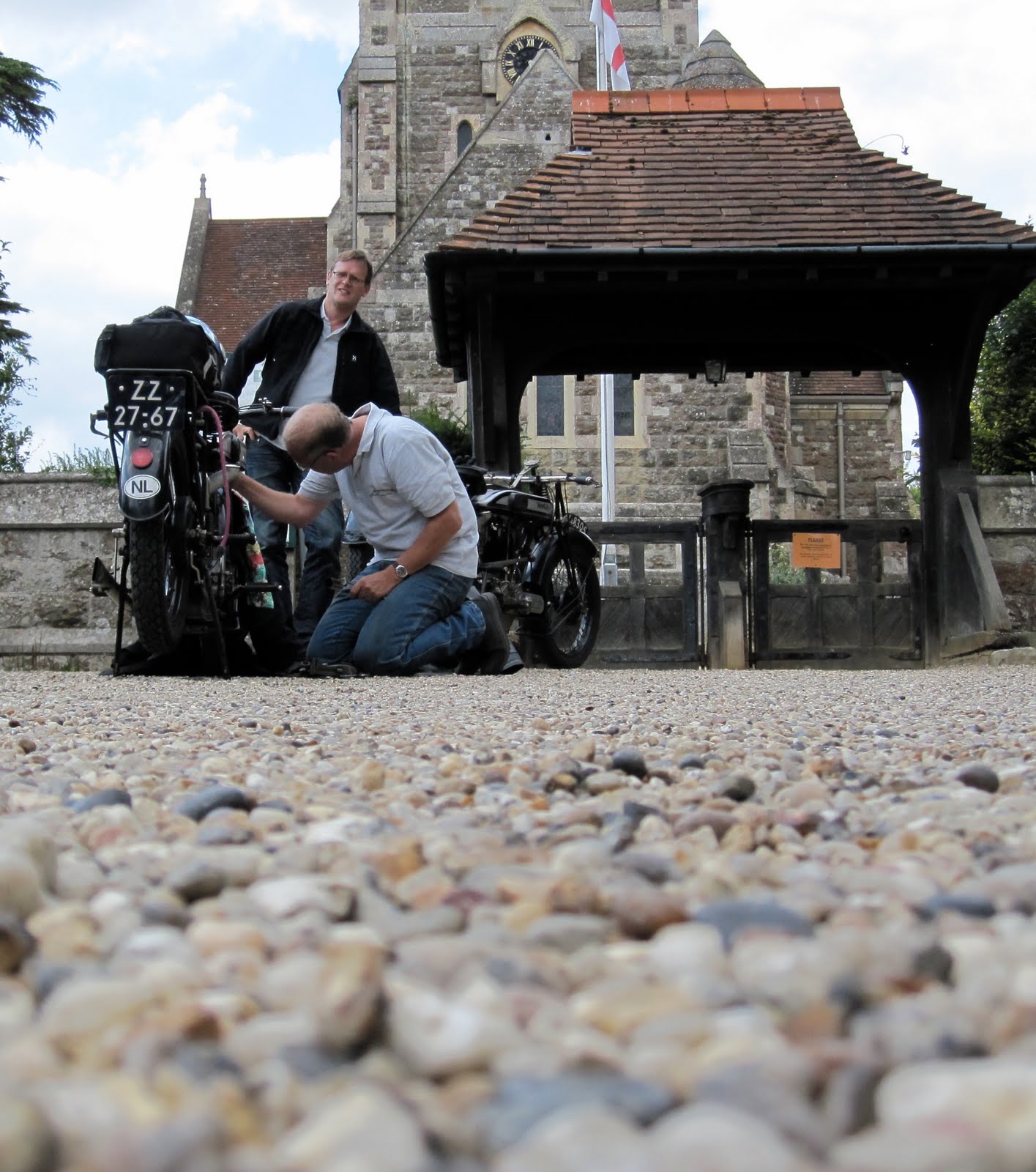
Rob and I went to the West Kent Run last week; rather disappointing as there were very few Nortons around but we had a great time visiting Verralls and Alf (fettling the Beemer in the pic below) and riding the Model 18's down the country lanes in Kent and Sussex.