-JdK- Kim in the UK contacted us and sent us the attached photo's of his dad's Nortons.


-JdK- David in the UK sent us this photograph and provided the text that follows: "I have a photograph of my father taken in 1938/39; he would be about 19 years old. He is sitting astride a Norton Inter. I think it is a lovely period image, it is black & white, he is dressed in collar and tie, tweed jacket and baggy trousers, and he looks as pleased as could be.
The story goes that he collected the bike from the “Low Level” railway goods station in Wolverhampton and rode it to his parents home in the suburbs of Wolverhampton. He was and remained until his death a fanatic for things motoring."
Richard had a look and comments: "It's always good to see photos from the time these bikes were used daily. The bike is either 1932 or 1933 but the interesting thing is it has a racing end-feed cambox. These were only fitted to the competition engines in the early 1930s so the cambox was probably fitted at a later date. I also see the front tyre is a trials pattern, so possibly used for grass track or sand racing before David's father bought it. The registration number is for Edinburgh, Scotland so it seems the bike had moved around. Note that it has a few non-standard bits and seems to have a dynamo run from the crank like the Moore OHC engines."

-JdK- Each summer Rob and I take a longer ride on our Nortons, We've been to the UK, Scotland, Ireland, Central Europe. This year we joined the BOM rally in the west of Belgium but when all the others returned to the Antwerp region we headed for the Alps.
In the past years we took our side valve Nortons, this year it would be different as we prepared our cammy Nortons, a 1931 CS1 and a 1932 M30. We've had these bikes for many years, they've seen a lot of work and modifications and we agree these are not the most practical bikes to take on a tour like this, most notably, it's more difficult to take luggage or spare parts, they can be pretty nervous in the unavoidable cities and the gearing is just not correct for climbing steep mountain passes.
Anyway, it was a lot of fun. We spent a few hours in Belgium fixing a positive stop mechanism and the M30 burned through six liters of oil but for the rest they needed no more attention than some light fettling. We did around 2500 km in eight days riding from the Netherlands into Belgium, Luxembourg, Germany, France, Switzerland, Austria and Italy; the map above was recorded by my Beeline SatNav. In case you are wondering, we did use the night train from Innsbruck to Dusseldorf for the ride home.


-JdK- Spent the weekend riding our Inters. All three are pretty non-standard but it doesn't matter at all, they go very well. Very few things are more enjoyable than racing three Inters through the north of Holland on a sunny Sunday morning.


Having owned, fixed and ridden pre-war cammy Nortons for over 20 years, this is the most original one I've seen. It's the one my late pal "Norton George" postulated (over a beer or two) must be out there - a pretty much untouched very low mileage example. It's a joy to ride. From the condition and specification of the engine internals, it is believed the mileage is genuine. As far as can be determines, the spec and finish of most of the components is absolutely correct.
It was cosmetically restored probably in the '70s, and sat in the Beaulieu National Motor Museum for many years. I mechanically overhauled it with a view to using it regularly (I've done over 1000 miles on it) and it starts easily, rides beautifully, and has proven to be very reliable.
It's had a top overhaul (valve springs, rings, cams, followers & tappets) and the TT magneto serviced. The original (plated brass) TT carburettor has been overhauled and is in fine condition. The brakes have been relined (and for the type, actually work well) and all rubber components and service items like chains, clutch shock absorber rubbers, & cables have been replaced. Most of the handlebar controls have been refurbished with the correct dull chrome finish, and the 100mph Bonniksen speedometer is absolutely accurate!
Some minor modifications have been made to make the bike more user friendly: The very low 1st gear (the rest are close ratio) has been replaced with a "Daytona" high 1st which retains the kick-starter, and a much more ergonomic gear-change lever fabricated and installed: all original parts have been retained, and there is a decent spares package which goes with the bike, including the original exhaust system. the bum pad is home-made, but correct replicas are available.
Notwithstanding the originality, this is a rider's bike. It deserves to be used, and not gathering dust in a collection... So for sale, SOLD. In case of interest contact Miles.


-SG- Back in December 2012 we had a posting about Norman Gledhill - amongst other things, winner of the 1932 Senior Manx. He looks understandably cheerful although somewhat bedraggled after a wet ride!
Many thanks to Paul. who in the last few days has sent us half a dozen further photos taken at Norman's home farm after returning from the IoM. The other chaps are local friends of his - the Livingstone brothers. The MGP Winner's Trophy looks pretty impressive!


-JdK- This is my 1930s International Norton, bought in September last year. I took the bike to B.O.M's Veteranen Tour in Belgium last weekend and as I hate to carry bikes on a trailer I rode the bike to Berlare, near Antwerp, did the tour on Saturday to Houffalize near Luxembourg and rode the bike back home near Utrecht on Sunday. All in all I did 585 miles - 940 km in three days without any issues. These pics were taken on Sunday evening and I did not clean the bike. Off course we've seen oil tight Nortons before but for a Carroll engined Norton this is pretty OK. Most of the oil it leaks now comes from a breather throwing oil in the magneto chain case and I guess it was designed to leak out this way as later Norton have a small tube in this chain case to drain excess oil. It runs on Castrol R40 bytheway.

What is it? The Norton came from the factory in 1933 as a Model 40. There's no mention of special tuning but it had no kickstart, racing footrests and racing chain guards and large tanks fitted. The engine currently fitted comes from a 1938 CS1 and has been in this frame at least since the 1960s according to the old green registration book. The girders are 1946, the gearbox late 1930s. Previous owners were James Gardner (1966), Henry Ormonde Gurr (1973, below) and Dennis Butler (1987). I think Butler had it sold by Andy Tiernan in 2021 to Dave who sold it to me in September last year.

There is a movie on YouTube (above) where Andy Tiernan talks about the bike and it's pretty funny. He remarks: "it was used by someone who went to Scotland on it, cruising at 70 and seeing 80. The engine was done by a well known gentleman in the engine world connected to Ricardo, but can't remember his name. It was done to a very high standard". I like Andy, he probably means Ormonde Gurr who was known to work on Ricardo Triumphs but it sounds a bit silly. If anyone knows more about any of the previous owners (except for Dave off course) then let me know!
Dave liked the bike a lot and did 3000 miles on it in one year which to me suggested the bike should be in decent condition and it ran OK when it arrived. But as always I expect to find plenty wrong with a 90 year old bike and I therefore took it to bits and rebuilt most of it over the winter.


I thought it would be nice to list what needed doing:
The engine was partly disassembled. The crank was left in situ, mainly because the pinion is stuck on the crankpin and I did not feel like applying a lot of heat and using a big hammer. The big end and mains feel fine and everything inside the engine looks clean. The standard CS1 piston looks unworn but the rings were stuck in the grooves which were cleaned. The small end bush was scored and therefore replaced. The guides and valve stems have some wear but were cleaned and reused as were the springs. The cam box was cleaned and new rubber and cork seals fitted. I did not change the timing while this seems to be a mixture between Model 30 and CS1 timing; inlet opens 45 BTDC, closes 60 ABDC; exhaust opens 85 BBDC, closes early at 30 ATDC. Compare this to the tabulated data we compiled. Perhaps this was the genius of the well known gentleman and Ricardo.
The gearbox needed a few new bearings and a thrust washer
Both wheels needed new bearings and new brake drums. The old drums had been skimmed which sounds like a good idea but the downside is that all standard size shoes are too small now giving a very spongy feel to the brakes. New drums fixed the problem.
The girders were rebuilt using new spindles. The headlamp was fitted with new brackets to position it somewhat lower. The 22 mm handlebars were replaced by proper 1" bars which cured the vibration. Numerous holes were welded in the guards and new brackets fitted. Weird-threaded bolts and nuts replaced everywhere. The internals of the dynamo were thrown away and the lights replace by energy efficient LEDs. The magneto was rewound. All petrol and oil hoses replaced. New tires fitted. New brackets and springs fitted to the saddle. New petrol taps.
Not too bad and it was worth it, this has quickly become one of my favorite Nortons. Not sure if it will do 70-80 MPH in Scotland but it was very happy cruising at 55-60 MPH in the Ardennes yesterday.


.jpg)
.jpg)
-SG- I recently came across Alain Daigne's 2012 French publication 'Manxman' - a collection of seventy photos of racing Nortons from 1900 to 1970. Two of the shots are of the 1934 works bike - photographed like many others over the years against a sheet held up in front of the office door. Grateful to Richard for what he has to say about it:
"The bike in the pictures is the 1934 works racer as used by Jimmy Guthrie to do the 1934 TT double. This was the year that the works engines were completely up-dated using full magnesium castings and bronze skull/ aluminium cylinder heads and aluminium barrels. The crankcases used the front top bolt to attach the engine to the frame for the first time, and the front down tube was fitted with 2 separate mounting lugs. The lower lug was fitted with the usual triangular engine plates and the higher lug had separate straight plates to the top crankcase bolt. The following year, 1935, the crankcases were re-designed and used the single set of front engine plates that were subsequently used on all racing spec. Inters and post-war garden gate Manx. This meant the 1935 frame lost the lower lug, although the 1934 double lug frames were still used with the later engines in some events. The other firsts for 1934 were aluminium petrol and oil tanks, and the Norton designed gearbox which were put into all the range for 1935. The exhaust system is a straight-through pipe but a megaphone was used for the 1934 TT and most other major events."
-SG- Early in December we posted a pre-war photo of (probably) Dick Lawton and his mid twenties Model 18. Peter Thomson (Thomson Motor Museum) came up with Dick as being the likely rider in the photo and he has also sent me copies of some Box Brownie snaps taken mainly at lower south island racing venues in the thirties and forties. Richard has had a look at these prints for us (all depicting OHC Nortons) and his comments and the photos follow on. Thanks to all concerned.

The machine above is a 1932 Model 30 that has seen some racing modifications from it's original specification. The engine has an early type positive end-feed cambox, as used on the works machines. The carburettor looks to have twin float chambers and the rev counter would be a much latter fitment. Other mods include the large muff fitted on the front brake drum, and the larger looking petrol tank which might have been made as a one-off for this bike. The centre stand was not fitted until late 1935 on production machines, but was designed to fit the existing frames and can easily be fitted to earlier machines.

This Inter above looks to be around 1938 and is fairly standard except for having the larger racing specification petrol and oil tanks. There are some other minor mods, such as racing mudguard etc., but it is not to full racing specification.

Above is a fairly standard 1934 or 1935 CJ Norton that has had a few parts changed for off-road competition with possibly a narrow pre-war trials petrol tank. Norton could supply any model to Trials specification, but this is does not have enough competition parts to be one of those.

Above is a 1936/7 Model 30 fitted with the optional bi-metal head and barrel, and also a positive end-feed racing cambox. The carburettor looks to have twin float chambers, so might be using alcohol fuel. The oil tank is from a 1932/3 model and the petrol tank looks like a pre-war trials type. The rest of the bike looks fairly standard, but stripped for competition.
.jpg)
.jpg)
-SG- I recently came across an article - I believe originating in the magazine Motor Sport in 1946 - concerning a talk Beart gave to the Hants and Berks Motor Club. Bearing in mind his audience were primarily car enthusiasts some may feel it is slightly slanted that way, but one has to remember that, post War, Beart was very much involved in the then new branch of motor racing involving 500cc cars - many powered by Manx Norton engines. Anyway, the article, slightly pruned, is attached!


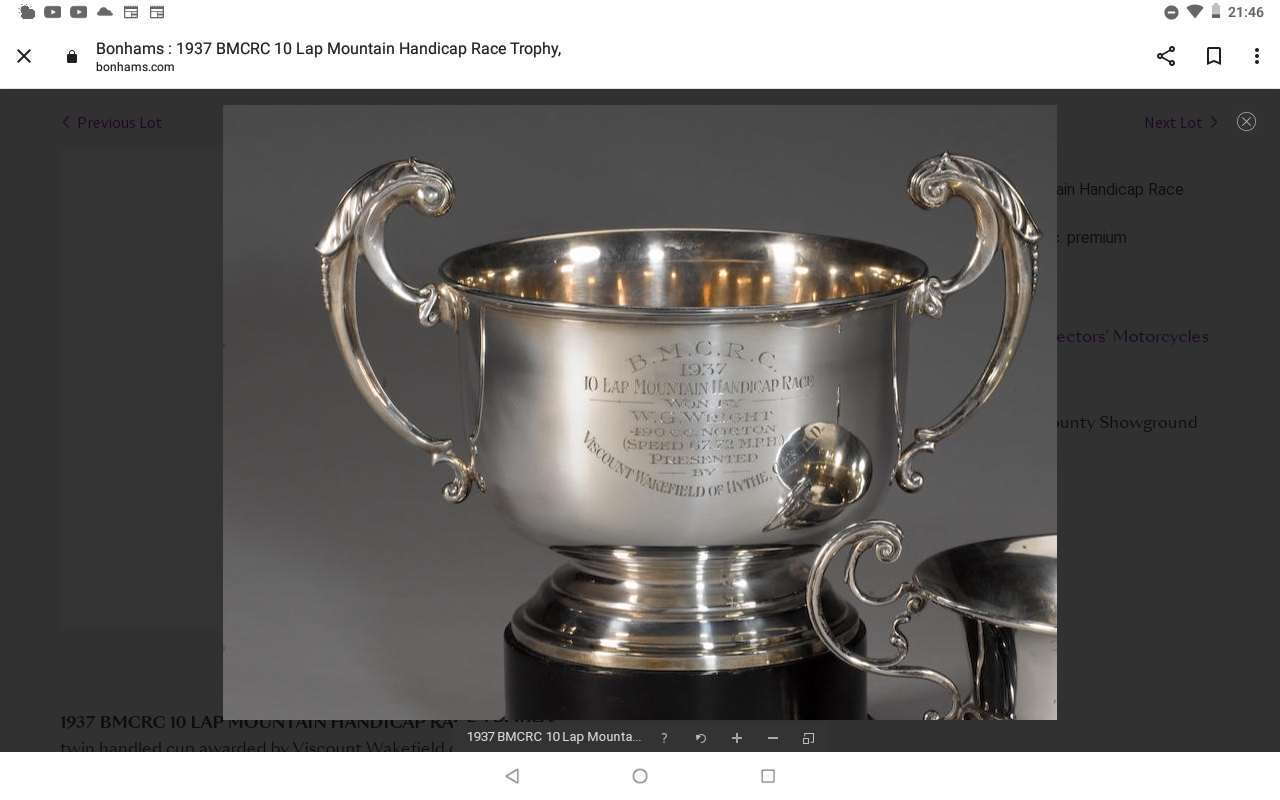
-JdK- Martin in Walsall in the UK contacted us about his 1936 Model 30. "I recently purchased a 1936 SOHC Norton. The bike came from an estate clearance in South London and appeared to have been used as a cafe racer. Upon looking at the Norton despatch records it is listed as racing specification and was sold via Ron Harris's shop in Maidenhead to W.G. Wright from Peterborough who then entered the Ulster grand Prix a few weeks later and came third. The next racing event I have found him at is Brooklands where he won the 1937 mountain championship race. Apart from these two races I have no other information on W.G. Wright.

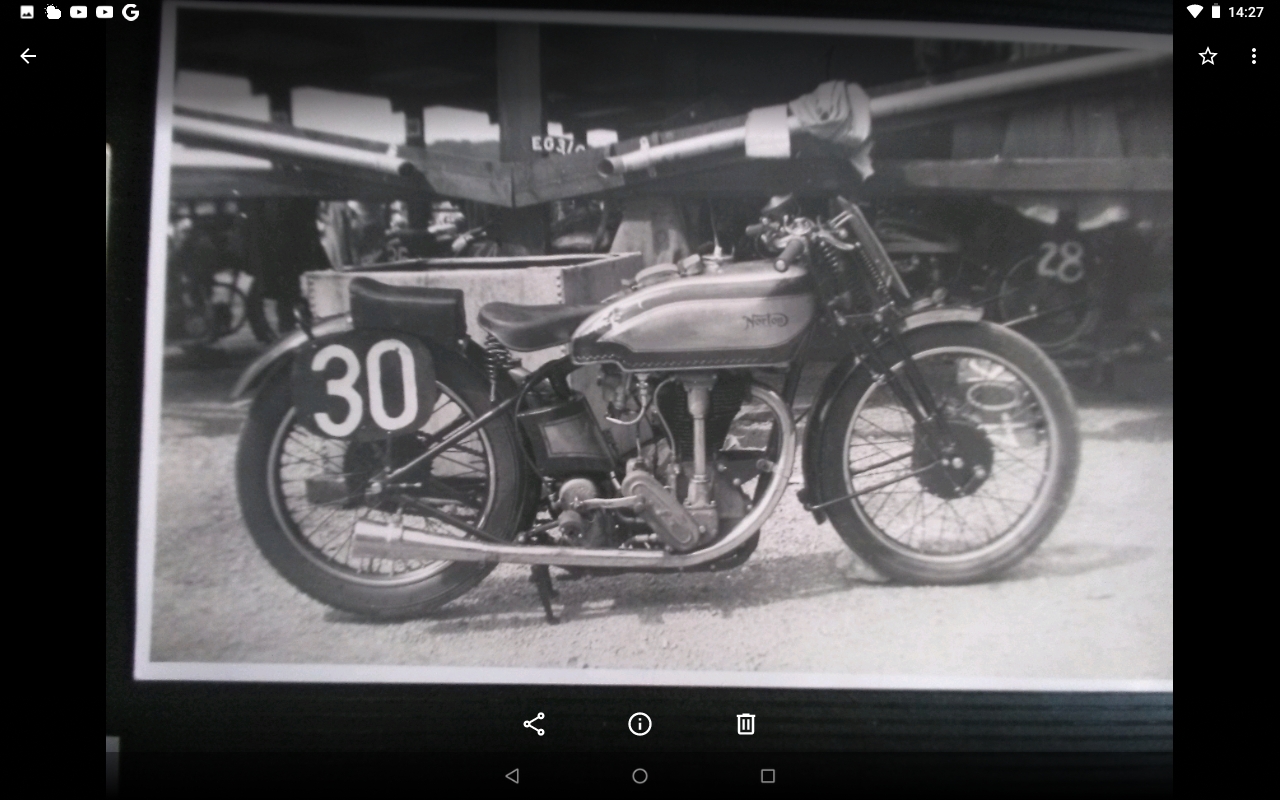

As for the bike I have the original petrol tank, oil tank and gearbox and intend to do an oily rag restoration. The frame, forks gearbox and engine all bear the correct numbers as confirmed in the despatch records held at the VMCC.The worst part appears to be the original crankcase which is quite badly corroded due to moisture, a great shame so should any of your readers have a spare set of longstroke magnesium cases I would be very interested. Anyhow I enclose a picture of the bike as found and a picture of W.G. Wright on the bike at Brooklands supplied by Niel Allman who is helping me with details of originality. So if any one could help with magnesium cases this would be greatly appreciated.

I also hope someone can shine a light on W.G.Wright. He has a small mention in Norton's 1937 and 1938 brochure, for his achievements at Ulster and Brooklands and after all he managed to buy a brand new race bike through Ron Harris, so he was an up and coming racer it appears. Maybe the second World War finished his motorcycle racing? Or maybe he just wasn't that good? Hopefully someone may know the answers and come forward with some information on a young racer that tried his best but never made works rider status."